
By Varun Patel, Founder & CEO of Crawlify | Jun 16, 2026 | 9 min read
Uptime ≠ Accuracy: The 98% Field-Accuracy Number No Competitor Will Publish
Bright Data guarantees 99.99% uptime. Apify guarantees 99.5% availability. Neither tells you if the data is right. Here's the difference — and the number we publish.
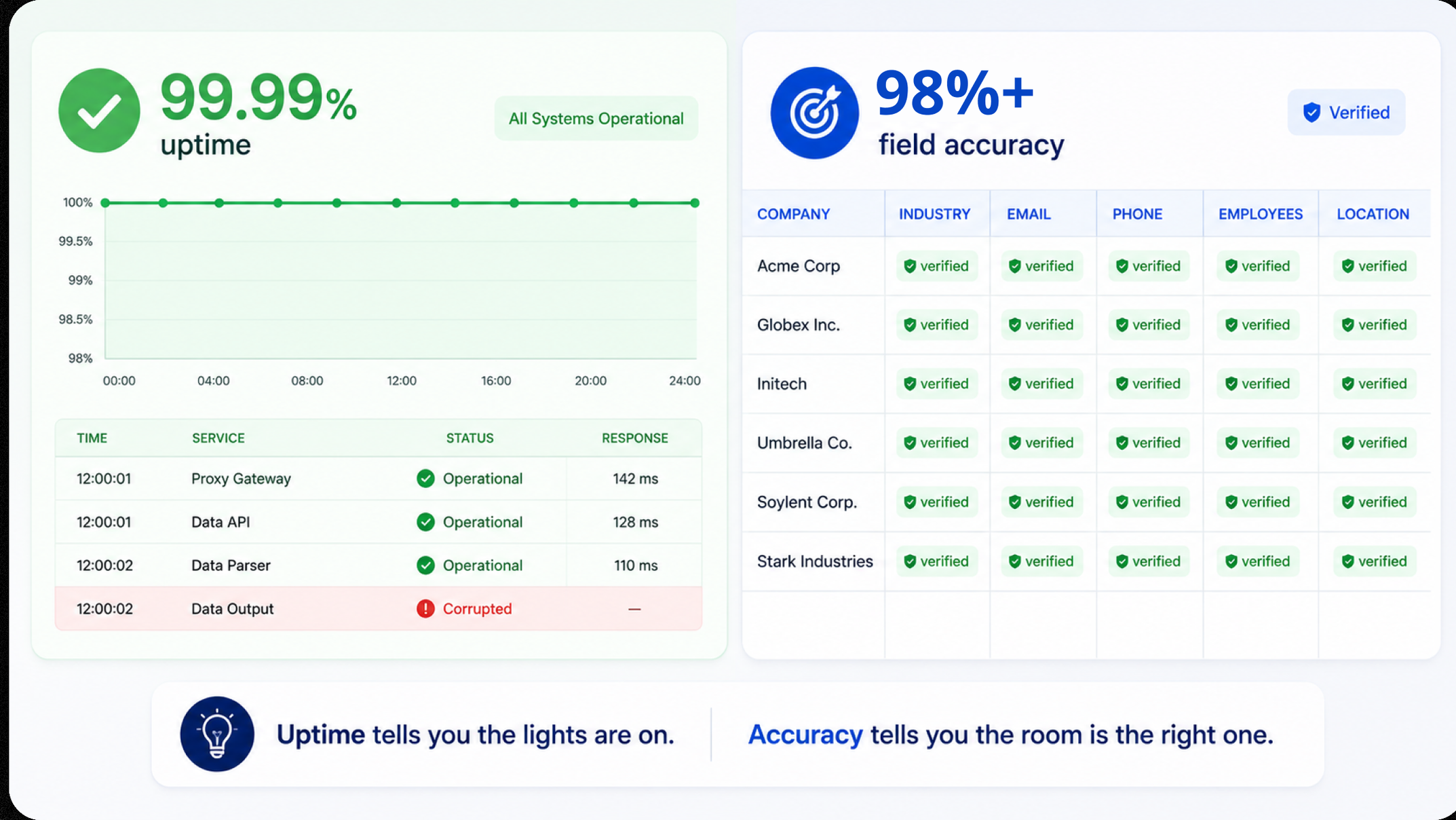
TL;DR — Bright Data publishes a 99.99% uptime SLA. Apify publishes a 99.5% availability SLA. ScrapeHero promises "accuracy" without a number. Zyte says 99.9% but won't publish the methodology. Every public number measures whether the request got through. None measure whether the data in the cell is correct. Crawlify publishes a 98% verified field-accuracy number, defines how we calculate it, and backs it in the pilot agreement. This is the difference.
The number every vendor publishes — and the one they don't
Open the SLA page of any scraping vendor and you will see a percentage. The number is usually 99-point-something. It looks like an accuracy claim. It almost never is.
Bright Data's SLA covers service uptime: 99.99 percent. Apify's Enterprise plan guarantees 99.5 percent platform availability. ScrapeHero, Oxylabs, Decodo, and the rest publish similar numbers, all measuring whether a request returned an HTTP 200. None of those numbers tells you whether the price in your database is the price on the page.
That is not a marketing oversight. It is the hardest number in the category to publish, because publishing it means defining how you measured it, accepting a number lower than 100, and standing behind it contractually. We publish it anyway. Here is why — and how we get there.
Where the public numbers come from
Two independent benchmarks set the modern reference points for what "success rate" means in this market:
- Scrape.do's 11-provider test (2025) measured request success across hard targets. Bright Data led with a 98.44 percent average.
- Proxyway's 2025 benchmark across 15 heavily protected sites measured success at 2 requests per second. Zyte API led with 93.14 percent.
These are excellent engineering numbers. They are also the wrong question for anyone running a pricing tool, a job board, or an alternative-data feed. A request can succeed and still return the wrong number. A page can load and still have its currency code change overnight. The HTTP response is not the data.
Definition check. Uptime measures whether the service was reachable. Success rate measures whether the request returned a 200. Field accuracy measures whether each extracted value matches ground truth. They are three different numbers. Most vendors publish one of the first two.
What the public SLAs actually cover
Side by side, the language is more telling than the percentages:
| Vendor | Public number | What it measures | Field-accuracy SLA? |
|---|---|---|---|
| Bright Data | 99.99% | Service uptime | No — public SLA is uptime only. |
| Apify | 99.5% | Platform availability (Enterprise) | No — availability only. |
| Zyte | 99.9% (claimed) | "Data accuracy", methodology unpublished | Marketing claim, not a contractual published number. |
| ScrapeHero | — | "Guaranteed accuracy" (adjective) | No number published. |
| Wiser Solutions | 98%+ | Product-match accuracy (one field) | Narrow scope; not a general field-accuracy SLA. |
| Crawlify | 98% | Verified field accuracy across the schema | Yes — methodology published; contractual in the pilot agreement. |
Sources: Bright Data SLA page; Apify Enterprise terms; Zyte managed-data and webinar pages; ScrapeHero product pages; Wiser product pages; Scrape.do 11-provider benchmark, 2025; Proxyway benchmark, 2025. Figures current as of June 2026.
Why AI alone stalls at about 95 percent
Independent industry data is consistent: pure AI extraction on production sites tops out around 85 to 95 percent field accuracy depending on site complexity. The remaining five to fifteen points are not random noise. They are a predictable set of failure modes:
- Schema drift — a retailer switches from "$" to "USD", or quotes nightly rates in two currencies on the same page. Pure AI will pick one and write it confidently.
- Contextual ambiguity — "Free" in a product card can mean free shipping, a free trial, or BOGO. The string is identical. The meaning is not.
- Cross-page duplicates — the same job posted across five cities. The same conference listed on five sites. AI sees five rows; the answer is one.
- Silent insertions and deletions — a site adds three records and removes one. The model still returns confident values, including for the row that no longer exists.
None of these throw an error. None of them break the request. The pipeline stays green. The data quietly turns wrong.
How Crawlify gets to 98 percent
We do two things every benchmarked vendor does — and one nobody publishes:
1. AI extraction with explicit schema contracts
Every source has a typed schema. Fields are not free-text; they are constrained types (currency, ISO country code, ISO 8601 date, boolean, enumerated category). The model proposes values; the schema validates them. Anything that fails validation is flagged before it touches the customer's table.
2. Human verification on every batch, sampled by risk
We do not have a person look at every row. We have a person look at every row that matters. Verification is targeted by three signals: low model confidence, schema-edge values, and high-impact fields (price, currency, dates, job status, event status). Reviewers see the page snapshot and the extracted row side by side. The reviewer's call becomes the ground truth.
3. A measured accuracy number, calculated the same way every week
Each week we sample a stratified slice of delivered records, send it to a second-line reviewer who has not seen the first pass, and compute precision, recall, and field-level accuracy. The headline number we publish — 98 percent — is field-level accuracy on the stratified sample, not request success. The methodology is in the pilot agreement. So is the remediation clause if a month drops below it.
What "field accuracy" means here. For a delivered row, count the number of fields whose value matches the reviewer's ground truth. Divide by the total number of fields delivered. Average across the weekly sample. A row with one wrong field out of ten counts as 90 percent, not zero.
What the difference is worth in dollars
Gartner's Magic Quadrant for Data Quality Solutions puts the average cost of poor data quality at $12.9 million per year at the enterprise tier. IBM's Cost of Bad Data work has put 1 in 4 companies above $5 million in annual loss from data quality alone. Those numbers will sound abstract until you cross-walk them to a 10-to-150-person company's actual exposure:
- A competitor pricing feed silently 2 percent wrong on a 1 million-SKU catalog mis-prices 20,000 items per batch.
- A job-board listing layer with a 20 percent ghost rate ships duplicate, dead, and never-filled roles into the customer experience. ResumeUp.AI puts that figure at 27.4 percent on LinkedIn; Greenhouse puts it at 18 to 22 percent across its base.
- An alt-data desk feeding a model with 15 percent silently wrong data does not see a system error. It sees a bad trade.
In each of those, the failure mode is not the scraper going down. It is the scraper staying up and being wrong.
Run a 5-day accuracy audit on your current pipeline. We sample your live feed, hand-verify a stratified slice, and report the real field-accuracy number against your schema. No credentials required — you send the data, we send the audit. Email audit@crawlify.ai or book a slot.
The ScholarMeet proof
Crawlify was first built to power ScholarMeet, our academic-conference aggregation product. Academic event data has the same failure modes as job listings and pricing feeds, with one twist: scholars notice. A wrong submission deadline is not a UX complaint; it is an angry email from a tenured PI.
That product is the reason this pipeline exists. The same verification layer that lets ScholarMeet stand behind dates, deadlines, and venue details for thousands of overlapping events is what now sits between Crawlify customers and their data tables. The accuracy number is not aspirational; it is what we already had to hit to keep a community of researchers trusting the feed.
Five questions to ask your current vendor this week
- Is your published number uptime, request success, or field accuracy? Can you point to the SLA page that says which?
- How is field accuracy calculated? Sample size, sampling method, who reviews, how often?
- What happens if a month drops below the number? Is there a remediation clause, a credit, or a service-level guarantee?
- How would I find out my feed was silently wrong this week — from you, or from a downstream customer complaint?
- Can I see a recent accuracy report on one of your live customers (redacted)?
If the answer to any of these is "we don't publish that," you now know what the published number actually covers. And what it doesn't.
What we publish, and why
Crawlify's public field-accuracy number is 98 percent. It is calculated on a stratified weekly sample, the methodology is in the pilot agreement, and the number is the number we owe back to the customer if a month underperforms. We did not invent the metric. We are publishing it because the rest of the category measures what is easy and calls it accuracy, and the customers paying for the data have learned to live with that. They shouldn't have to.
If you run a pricing tool, a job board, an events platform, or an alternative-data desk and you cannot tell me your current field-accuracy number, that's the conversation worth having.
Talk to us. Free 5-day audit of your current feed, or a 30-minute scoping call. Either way you leave with a real field-accuracy number on your own data. Get in touch.
Frequently Asked Questions
