
Compliance & Security
Public data, collected responsibly. Every record traceable.
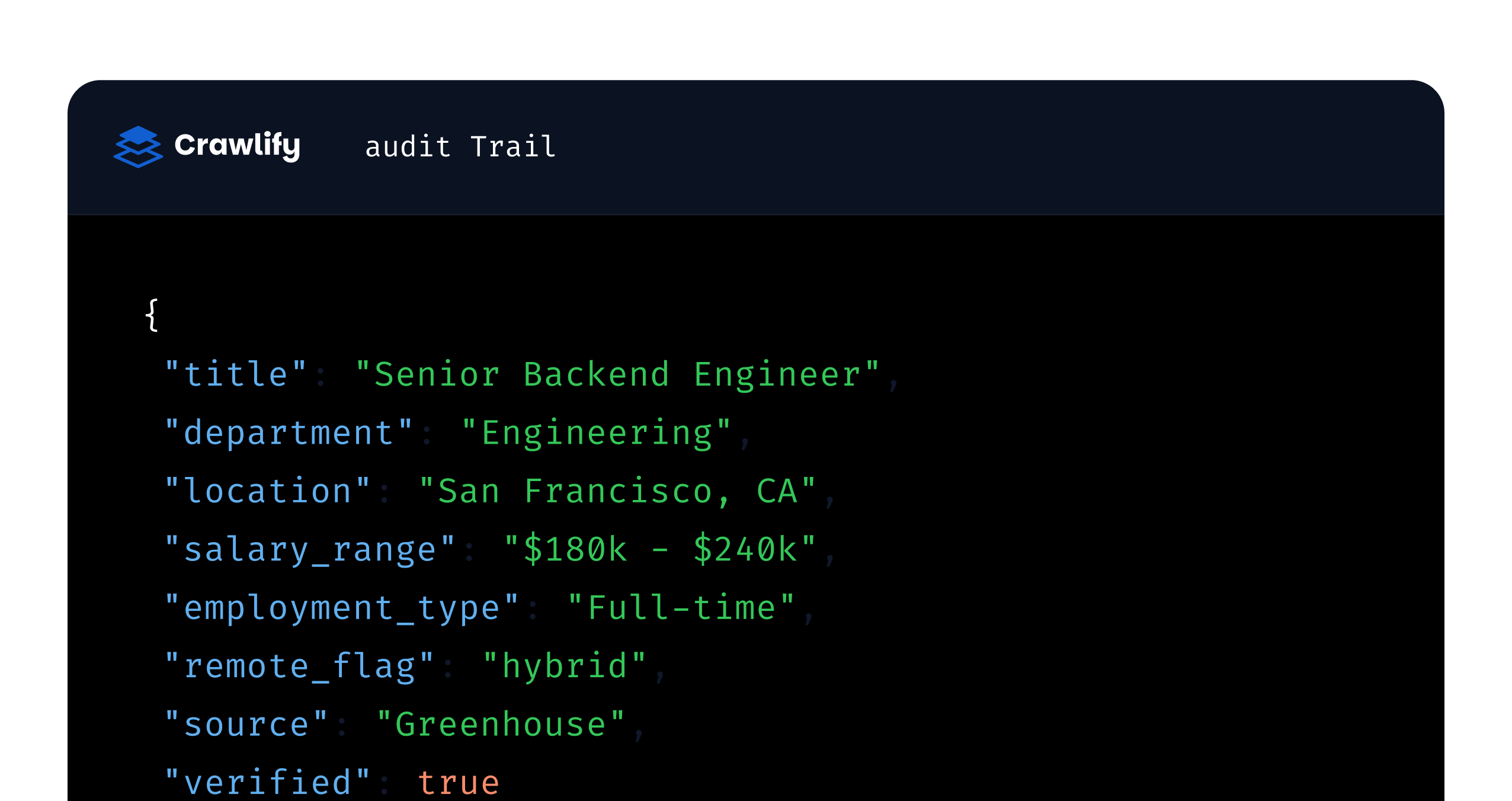
Crawlify extracts only publicly available web data. We do not collect personal data, access authenticated content, or circumvent technical access controls. Every record in every delivery carries a full provenance trail: source URL, extraction timestamp, verification analyst, and verification timestamp.


Data Collection Principles
Six principles that govern every extraction.
The rules aren't fine print. They shape what we touch, how we touch it, and what we hand back — on every single record.
- 01Access
Public data only.
We extract data from publicly accessible web pages. We do not access content behind login walls, paywalls, subscriptions, or authentication barriers. If a page requires credentials to view, we don't touch it.
- 02Privacy
No personal data collection.
We do not target personal data (names, emails, phone numbers, addresses) as a primary extraction objective. When job postings or government records incidentally contain public contact information (for example, a contracting officer's email on SAM.gov), that data is treated as part of the public record, not as a lead-generation output.
- 03Respect
Robots.txt compliance.
We respect robots.txt directives. If a site's robots.txt restricts automated access to specific paths, we honor those restrictions. We do not override, bypass, or ignore robots.txt.
- 04Stability
Rate-limited, low-impact crawling.
Our crawlers are rate-limited to avoid impacting source server performance. We distribute requests across time windows, use appropriate delays between requests, and monitor for signs of server strain. We do not flood, overload, or degrade the availability of any source.
- 05Integrity
No circumvention of access controls.
We do not bypass CAPTCHAs, login gates, IP blocks, or other technical measures designed to restrict automated access. When a site deploys anti-bot measures, we treat that as a signal to assess whether automated access is appropriate for that source.
- 06Traceability
Full provenance on every record.
Every record in every delivery includes the source URL it was extracted from, the date and time of extraction, the analyst who verified it, and the date and time of verification. This audit trail is immutable and available to the customer.
Privacy & Data Protection
GDPR. CCPA. And the standards that come next.
Crawlify is aware of and designs its extraction practices around the requirements of major data protection frameworks. We do not process personal data at scale. For projects involving data from EU/EEA sources, we apply GDPR-aware extraction practices: no collection of personal data behind authentication, no profiling, no direct marketing use of scraped personal information.
We extract public institutional data (legislation, tenders, drug prices, job postings), not personal data behind authentication. When incidental personal data appears in public records, we document our lawful basis (legitimate interest or public task) and provide deletion pathways.
Industry-Specific Compliance
Built for the industries that take data seriously.
Every vertical brings its own rulebook. These are the four where the question comes up first, and the answer we give each of them.
Financial Services
All data is sourced from publicly available job postings, pricing pages, and corporate disclosures. No MNPI (material non-public information). No expert-network inputs. No insider sources. Point-in-time snapshots are immutable. Full audit trail for every record supports compliance review and backtest integrity.
Explore The Solution



Legal Landscape
The legal foundation for public web data extraction.
A brief, factual summary of the key precedents that shape public web data extraction. This is not an exhaustive review.
The Ninth Circuit held that scraping publicly accessible data does not violate the CFAA. If information is open to any visitor without a login, accessing it programmatically is not “unauthorized access.” Public means public.
This is not legal advice. Crawlify provides data extraction services, not legal counsel. Customers should consult their own legal teams for compliance review of specific use cases.
Security Practices
How we protect your data and ours.
Data in transit
TLS 1.2+ encryption on all connections.
Data at rest
Encrypted storage (AES-256).
Access control
Role-based access, MFA for all team members.
Delivery security
Encrypted delivery channels (SFTP, S3 with IAM, HTTPS API).
Incident response
Documented incident response plan.
Infrastructure
Hosted on AWS with standard security configurations.
No third-party data sharing
Customer data is not shared, sold, or used for any purpose other than the contracted delivery.
We do not currently hold SOC 2 or ISO 27001 certification. As we scale, these certifications are on our roadmap. In the meantime, we provide detailed security documentation on request.
Frequently asked questions
No. We extract only from publicly accessible pages. No credentials, no authentication bypass, no paywall circumvention.
Need compliance documentation for your review?
We provide detailed compliance and security documentation on request. If your legal or compliance team needs to review our practices before proceeding, we are ready.
No credit card. No commitment. Just clean data.