
URL & location continuity
Every address supplied by you, the ISSN Portal, OpenAlex, DOAJ and other agreed sources is classified: serving the journal, a legitimate redirect, moved, stale, dead, parked, for sale, or serving unrelated content.
Journal Web & Metadata Monitoring
Monitor journal URLs, indexing claims and public metadata across the ISSN ecosystem, scholarly databases, publisher websites and historical web records. When something materially changes, Crawlify gives you the before, the after and the evidence behind it.
Global service · evidence-backed findings · human verification for material alerts
Journal of Sample Agronomy
No change detectedVerified change


One-time vetting
Crawlify managed
The reframe
A journal record may be correct when it is created or reviewed. The live web keeps changing after that.
Journals move to new publishing systems. Old URLs remain in databases. Domains expire or change use. Publisher infrastructure changes. An indexing status can change while an older claim remains visible on the journal website.
Individual systems may maintain their own records, but no single record tells you whether every external address, claim and historical reference still matches the journal today.
The problem is not that every change is suspicious. In our 100-journal study, 31 of 32 observed moves were legitimate migrations. The monitoring problem is knowing that the change happened, separating normal change from a material discrepancy, and preserving the evidence.
Definition
Journal monitoring is the recurring, evidence-backed check of a journal list. It tracks where each journal currently lives on the web, whether public-metadata addresses still lead there, whether current indexing claims match authoritative sources, and whether observable metadata has materially changed. Crawlify does not decide whether a journal is good, bad, legitimate or predatory. It keeps the underlying evidence current so your team can make that decision using fresher information.
Every journal on your list, checked against the public records and URLs associated with it.
Journal of Sample Agronomy
No change detectedISSN Portal
Current
Database URL
Current
Index Claim
Scopus supported
Sample Review of Linguistics
URL update neededISSN Portal
Old domain for sale
Database URL
Current location found
Index Claim
DOAJ supported
Example Journal of Signal Studies
Indexing status changedISSN Portal
Current
Database URL
Current
Index Claim
Scopus discontinued
Illustrative Medical Letters
Location unresolvedISSN Portal
No DNS
Database URL
No current URL
Index Claim
—
Historical state
2018-06-02
Journal website
Current state
2026-09-24
Unrelated commercial content
Verified change · historical evidence retained
The Research
94 / 100
sampled journals were identifiable online at the time of review
31 / 32
observed journal moves were legitimate migrations
Change itself is usually normal. Knowing that it happened is the monitoring problem.
6 / 97
journals with historical web evidence had a former journal-associated domain that served unrelated content, or had done so before going dark
1 / 17
explicit Scopus claims checked was no longer current in the latest Source List used for the study
2 / 26
explicit DOAJ claims checked were not supported by a current DOAJ journal record at the time of review
Research sample: 100 India-assigned journals selected under the published study methodology. These figures describe that sample only and are not prevalence estimates for India or the global journal population.
Capability
Monitoring is configured per journal list — which sources we check, how often we look, and what counts as a material change worth surfacing to you.
Every address supplied by you, the ISSN Portal, OpenAlex, DOAJ and other agreed sources is classified: serving the journal, a legitimate redirect, moved, stale, dead, parked, for sale, or serving unrelated content.
When a journal URL fails or changes, we inspect the registrable domain and relevant historical snapshots to separate ordinary migration from an expired domain now used for something else.
Scopus claims are checked against the latest Scopus Source List and DOAJ claims against the current DOAJ record. Other indexes are verified only where an authoritative source is accessible, and returned as “not verifiable” otherwise — never marked false for lack of access.

Title, ISSN/eISSN presentation, publication frequency, publisher and current URL are compared where a reliable baseline exists. Source availability differs by country, so we never promise the same fields are comparable everywhere.
Material findings keep their source, observed and final URLs, timestamps, before and current values, and a saved snapshot or screenshot where appropriate, with an evidence status attached.
Monthly, quarterly or a custom cadence. After the baseline, each run reports only what's new: changed records, broken URLs, migrations, indexing changes and material metadata changes.
How It Works

ISSNs, eISSNs, journal titles or current URLs — tell us which sources to monitor, how often to check, and which fields matter to your workflow.
We establish each journal's known identity, current location, public-metadata URLs, relevant historical evidence, current index claims and comparable metadata fields. The initial 30-day pilot baselines up to 100 journals.
Automation identifies candidate changes. Material findings are reviewed against the captured evidence before delivery, and returned as confirmed, not verifiable, or insufficient evidence — never delivered as an unsupported allegation.
One journal-level monitoring record and one record per confirmed change, with before/after, timestamps and evidence references — as a spreadsheet, API, webhook or warehouse delivery where agreed.
Crawlify Research
We audited 100 journals across live websites, public scholarly metadata, historical web evidence and indexing records. The study surfaced legitimate migrations, stale journal locations, repurposed former domains and indexing claims that no longer matched the current source.
31 of 32 observed moves were legitimate · 6 of 97 had former journal-associated domains with unrelated-content history · 1 of 17 Scopus claims and 2 of 26 DOAJ claims did not match the current authoritative record used in the study
Read The Study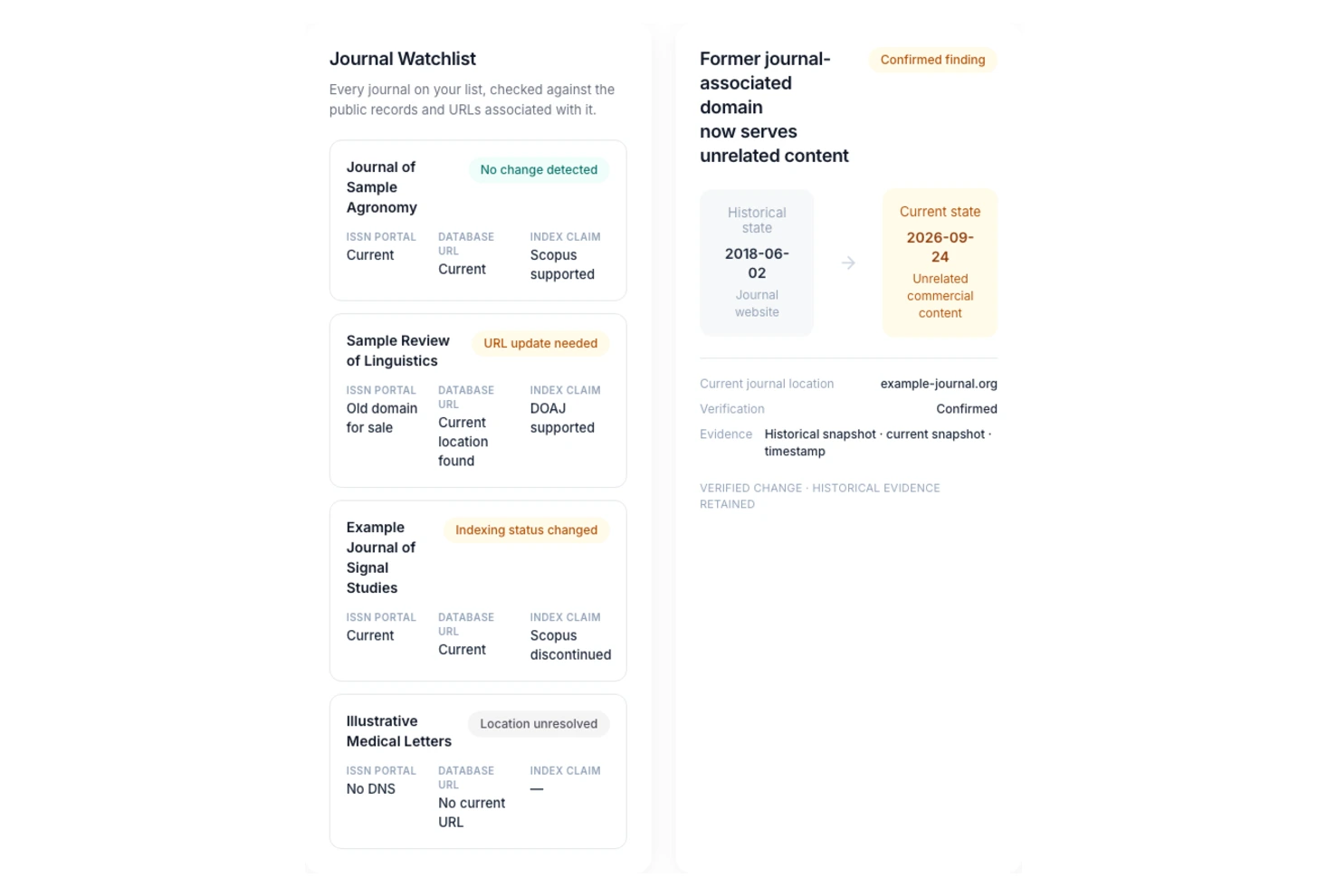
Manual vs Managed
| Stage | Periodic manual reviewReconciled by hand, one source at a time. | Crawlify managed monitoringRecurring, cross-source, with evidence retained. |
|---|---|---|
| Check whether recorded URLs still locate the journal | Requires opening and reconciling each source manually. | Re-checked on the agreed monitoring cycle. |
| Detect a journal move | Usually found when someone notices a broken or changed link. | Old and current locations compared and recorded. |
| Inspect a failed historical URL | Requires separate archive and domain investigation. | Domain/root and historical evidence collected when needed. |
| Verify current Scopus / DOAJ claims | Requires manual lookup in each index. | Claims checked against the agreed authoritative source. |
| Track comparable metadata | Manual before/after comparison. | Changes surfaced where reliable baselines exist. |
| Preserve evidence | Often scattered across notes or browser tabs. | Before/after evidence retained with timestamps. |
| Repeat the process | Repeated manual effort. | Recurring monitoring with change-only reporting. |
Who this is for
Delivered to every team on the record
For institutions in India
UGC discontinued the UGC-CARE scheme and subsequently notified suggestive parameters for faculty members, students and higher-education institutions to choose peer-reviewed journals. Crawlify does not replace that evaluation. It can keep the underlying web, indexing and metadata evidence current between institutional reviews.
A recurring check of a journal list that tracks where journals currently live online, whether recorded addresses still lead there, whether current indexing claims match the authoritative index, and whether comparable public metadata has materially changed.

Send us up to 100 ISSNs for a 30-day pilot. We will establish the current journal locations, check the public addresses and indexing claims in scope, preserve the evidence behind material changes, and show you what recurring monitoring would report.

Crawlify can deliver recurring journal identity and change data as a managed data pipeline for research-intelligence, discovery and scholarly-data products.