
By Varun Patel, Founder & CEO of Crawlify | Aug 5, 2026 | 12 min read
The Phantom Competitor: Why Repricing Engines Discount Against Stores That Already Sold Out
Repricing engines cut margin against competitors who sold out days ago. The failure isn't speed — it's running a price feed without a stock feed. Here's the pipeline architecture that catches it.
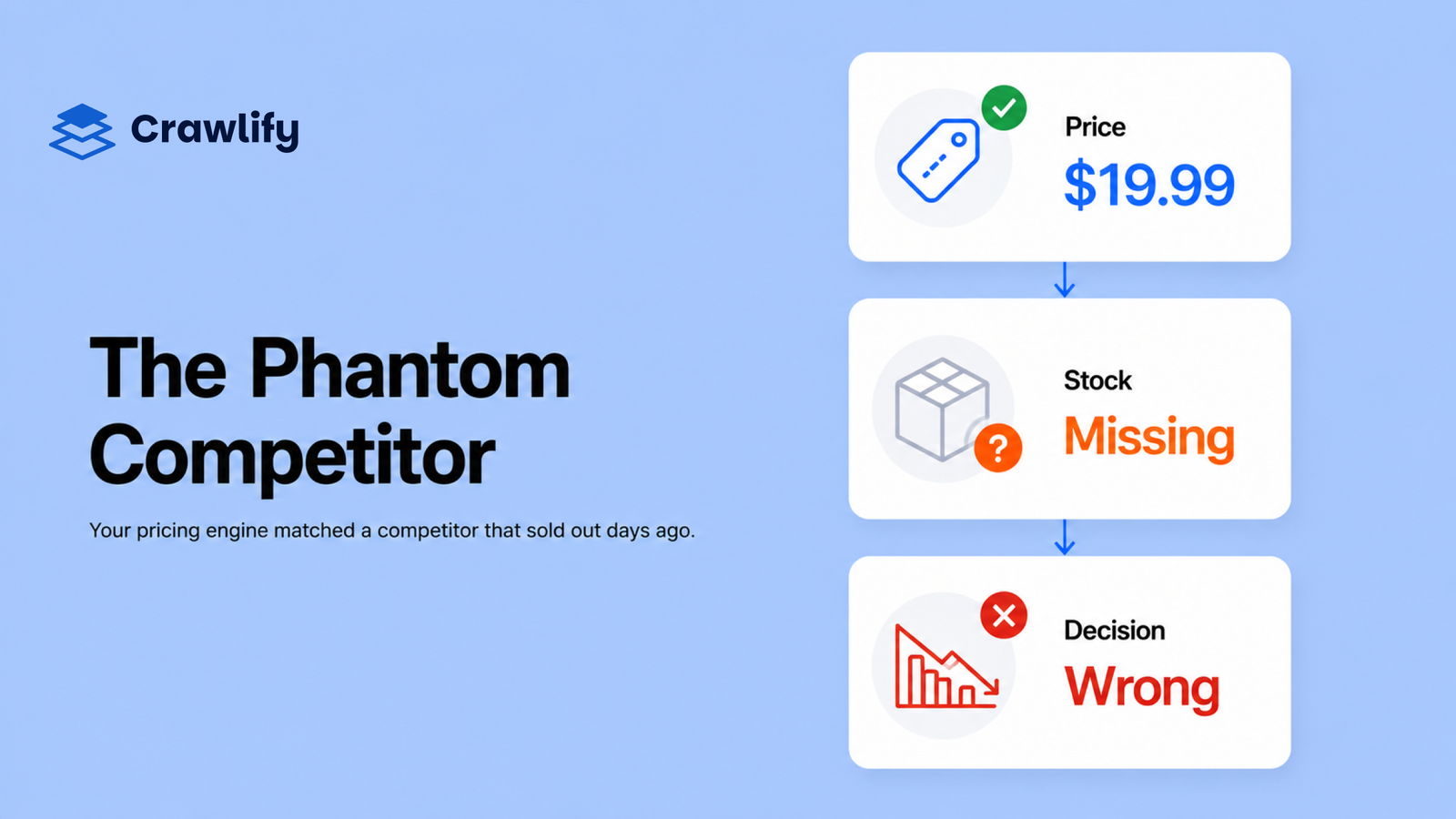
TL;DR — Your repricing engine cut prices to match a competitor. That competitor sold out three days ago, and your scraper never noticed. The price feed said "$19.99." The stock feed, which nobody ran, would have said "sold out." One pipeline was accurate. The conclusion was still wrong. This is the phantom competitor, and it is not a speed problem. It's what happens when a price feed runs without a correlated stock feed. A 1 percent pricing error erases 6 to 7 percent of operating profit (Revology, 2025), and frontier AI models score 0 percent valid output on complex pricing schemas (ExtractBench, 2026). Verification catches wrong values. Correlation catches wrong conclusions. Most pricing tools do neither.
What a phantom competitor is
A phantom competitor is a listing your repricing engine treats as a live rival when it is not. The competitor is out of stock, delisted, or otherwise out of the market, but the price it last showed is still sitting in your feed. Your engine matches or undercuts that price and discounts into thin air, because its intelligence is single-signal: price only, no stock, no availability, no correlation.
The mechanics are ordinary, which is what makes them dangerous. Seller A drops a price. Seller B's algorithm undercuts to defend the Buy Box. Seller A sells through their inventory and goes out of stock, but the listing's last price is still there to be read. Seller B's scraper reads it, sees an unchanged number, and keeps cutting to beat a competitor who is no longer selling anything. Multiple sellers run automated repricers, so a single price drop can trigger a downward spiral of bots undercutting each other, and when the seller who started it depletes inventory, everyone else keeps matching a ghost.
This isn't a hypothetical. RepricerExpress, a repricing vendor, explicitly advises merchants to use a "Sleep Mode" to manually pause repricing and force competing bots to reset, treating price wars as an operational inevitability rather than a solvable data-correlation problem. The workaround exists because the underlying feed can't tell a live competitor from a dead one.
The most expensive version of this failure is old and well documented. In April 2011, two Amazon sellers listed the same out-of-print biology book, The Making of a Fly, and let their algorithms fight. One priced at 0.9983 times the competitor; the other at 1.270589 times the lower offer, an intended dropship margin. Neither algorithm checked physical inventory or sanity-checked its own output against a rational bound. The feedback loop ran unattended until the book was listed at $23,698,655.93, plus shipping. Two accurate price-reading algorithms produced one absurd conclusion, because nothing in the loop asked whether the number made sense or whether the thing was even for sale.
The false velocity myth
The pricing-intelligence category's answer to this is almost always speed. Faster scrapes. Higher refresh frequency. Real-time feeds. The pitch assumes that if you read the price often enough, you'll catch the moment it becomes wrong. But the phantom competitor is not a stale-read you can out-run. A competitor who sold out three days ago will read as the same price at 15-second intervals as at daily intervals. Reading a ghost faster does not make it less of a ghost.
The category's foundational stat is itself a casualty of the problem it claims to solve. The number everyone quotes — "Amazon changes prices 2.5 million times a day" — traces to a single Profitero press release from December 2013. No updated empirical measurement has been published in the thirteen years since. The entire sector sells 2026 AI solutions on top of a 2013 assumption because nobody verified the foundational figure. It is, precisely, stale data treated as current: the exact failure mode the industry sells tooling to prevent.
The gap this leaves is not extraction speed. Despite dynamic pricing being widely available, roughly 71 percent of companies still rely on scattered, ad-hoc competitor price tracking (Xenoss / Retail Systems Research). The missing piece is not a faster crawler. It's basic pipeline infrastructure that verifies a value and correlates it against the other signals that decide whether the value means anything.
What bad pricing data actually costs
Pricing errors are financially asymmetric. They almost always compress margin and almost never expand it, because a wrong-low price ships to customers instantly while a wrong-high price gets corrected by the market. The leverage runs the wrong way.
The core number is from Revology Analytics ("Pricing Still Packs a Punch," June 2025): a 1 percent improvement in price realization generates a 6 to 7 percent increase in operating profit in general, and up to 11 percent in unregulated B2B industries. Run that in reverse. A phantom-competitor error that drops price 2 percent can erase a material share of a quarter's operating profit, on a single category, from a single stale feed. Broaden it out and the silo cost compounds: OmniBound's 2026 study puts the revenue hit from B2B pricing inefficiencies at up to 31.8 percent and the margin hit at 17.1 percent when systems operate in isolation from one another.
When the failure happens at the delivery stage instead of the decision stage, the losses are immediate and large. In December 2014, a RepricerExpress sync error listed thousands of items at £0.01; individual small businesses lost up to £100,000 overnight because the fulfillment pipeline executed the flawed data with no verification gate in front of it. In 2024, Qantas honored wrongly discounted first-class fares after a comparable automated pricing glitch. In both cases the systems worked exactly as built. They pushed a number to a checkout without ever asking whether the number was real.
There is now a regulatory tail on top of the financial one. More than 40 bills were introduced across 24-plus US states in 2026 to regulate algorithmic pricing (MultiState; Inside Privacy). Unverified repricing is no longer just a margin risk. It's an emerging compliance exposure, and "our algorithm did it" is not a defense that improves with an audit trail you don't have.
See what a verified pricing feed looks like for your category. Pick a few competitor sites and a slice of your SKUs. We'll deliver a verified pricing snapshot — price, stock, promo flag, source URL, and a verifier ID and timestamp on every record — so you can see the correlation your current feed is missing. crawlify.ai/pilot · hello@crawlify.ai.
Where in the pipeline each failure is born
Every pricing failure in this post is born at a specific stage of the pipeline, and each stage has its own root cause. Mapping them is the difference between "our pricing data is bad" and knowing where to put the fix. A managed pipeline is really four stages — Extract, Monitor, Verify, Deliver — and each one fails in a characteristic way.
| Stage | Failure mode | Root cause | Evidence |
|---|---|---|---|
| Extract | Hallucinated or incorrect values | LLMs silently invent JSON values; CSS selectors break on a UI update | ExtractBench 2026: 0 percent valid output on 369-field schemas |
| Monitor | Phantom competitor (stale data) | Pipeline runs clean but caches stale HTML; schema drift undetected | Monte Carlo: roughly one major incident per year per 15 production tables |
| Verify | Race to the bottom (untethered logic) | No systematic truth check; validators test shape, not truth | The $23.7M book; the RepricerExpress £0.01 glitch |
| Deliver | Channel desync and mass margin loss | Batch updates lag real time; systems push errors straight to fulfillment APIs | Qantas 2024 fare glitch; RepricerExpress auto-fulfillment |
Sources: ExtractBench (arXiv, 2026); Monte Carlo data-reliability research; Michael Eisen (michaeleisen.org, April 2011); The Guardian and City A.M. (December 2014); news reporting (2024).
The phantom competitor lives at the Monitor stage. The pipeline runs without an error because reading a stale price is technically a success. The value is well-formed, the request returned a 200, the freshness check passed if it only asks "did we get a response today." What's missing is a second feed running alongside it, and a step that asks whether the two agree.
The AI extraction myth
The industry's current answer to data quality is that large language models have solved structured extraction. They have not, and the benchmark that shows it is the strongest single result in this whole discussion. ExtractBench (arXiv, 2026) evaluated frontier LLMs on complex, enterprise-scale schemas and found a 0 percent valid output rate on 369-field pricing and financial schemas. Not a low rate. Zero.
The reason the industry keeps believing otherwise is that LLMs are excellent at one half of the problem and silent about the other. Schema compliance — producing syntactically valid JSON that fits the shape you asked for — stays high. Value accuracy, whether the number in the cell is the number on the page, is a different metric, and it collapses under load. ExtractBench measured value accuracy dropping from 83.0 percent on clean text to 67.2 percent on visual page layouts to 0 percent on complex financial and pricing schemas.
The critical distinction is one the category consistently blurs. An AI extractor guarantees that a scraped data point looks like a price. It cannot guarantee the price is real. Schema compliance is not value accuracy, the same way data shape is not data truth. A model will confidently hand you $19.99 for a product that is out of stock, out of catalog, or invented outright, and it will hand it to you in perfectly valid JSON. The formatting is not the hard part. The truth is.
From accuracy to intelligence: the correlation layer
Verifying a single feed catches wrong values. It does not catch wrong conclusions, because a conclusion is drawn across feeds, not within one. The phantom competitor is a correlation failure, not an extraction failure. The price was right. The decision was wrong, because the price was never joined to the one other signal that gave it meaning. The fix is a layer above verification: cross-pipeline correlation.
Price with stock is the phantom-competitor antidote directly. When price is correlated with availability, the system can tell a competitor liquidating their last units from one making a strategic price cut, and it can hold your price steady, wait for the stock-out, and reclaim the margin instead of chasing a store on its way out of the market (Simon-Kucher B2B Dynamic Pricing Insights, 2026). This is the exact correlation the phantom competitor exploits by its absence.
Price with channel closes the cross-channel desync hole. Third-party repricing tools routinely fail to calculate shipping differentials between fulfillment networks, pushing landed cost into unprofitable territory. Correlating your own first-party data against external marketplace scraping is what prevents the arbitrage holes that a price-only view can't see.
Price with AI visibility is the frontier. Tracking a brand's visibility in LLM outputs — ChatGPT, Perplexity, Google AI Overviews — without correlating it to the underlying commerce data (pricing, reviews, stock) can tell you a product appeared or disappeared but never why. Visibility-only tools and commerce-data platforms sit in structurally separate silos today. Bridging them is a large block of uncaptured value, and it's the same architectural move as price-with-stock, one layer up.
The vendor landscape splits cleanly along this line: who verifies, and who correlates.
| Vendor type | Price | Stock | AI visibility | Correlation | Primary value |
|---|---|---|---|---|---|
| Crawlify (managed) | Verified | Verified | Roadmap | High | Verified, correlated signal intelligence |
| Competera | Yes | Limited | No | Medium | Algorithmic optimization plus basic QA |
| RepricerExpress | Yes | Internal only | No | Low | High-speed marketplace repricing |
| Commodity scrapers | Raw | Raw | No | None | Proxy networks and raw HTML extraction |
| GEO tools (Semrush) | No | No | Yes | None | Brand visibility in LLM outputs |
| Profitero | Yes | Yes | No | Medium | Enterprise market-share tracking |
The category is crowded on the left three columns and empty on the fourth. Almost everyone can hand you a price. Fewer can tell you the stock beside it. Nobody in the mainstream stack is joining price, stock, channel, and visibility into one correlated, decision-ready record with a verifier ID on each field.
Verified, then correlated, then delivered
The two failures in this post sit one level apart, and both matter. Verification is what caught the wrong value at the silent-scraper stage — the field that reads $0.00, or the currency that drifted, or the row that quietly went stale. Correlation is what catches the wrong conclusion at the phantom-competitor stage — the value that is individually correct and collectively misleading. A pipeline that does only the first ships accurate data that still leads you to a bad decision. A pipeline that claims to do the second without the first is correlating noise.
This is why the 99.5 percent field-accuracy number is the floor and not the headline. Verification produces a number you can trust per field, per record, with a verifier ID and a timestamp attached; the methodology is in the pilot agreement and there's a remediation clause if a month underperforms. Correlation is what turns that trusted field into a signal you can act on. The ScholarMeet pipeline Crawlify was first built to power runs on exactly this shape: verified records, correlated across sources, delivered where the customer already works. The academic-event version of a phantom competitor is a conference with the wrong date on four aggregator sites, and it fails the same way a sold-out SKU does, for the same reason.
"Real-time pricing data" is a race everyone loses, because wrong-faster is still wrong. A repricer that sees a price twelve hours late is slow, and slow is fixable. A repricer that sees a price instantly but never checks whether the competitor is in stock is blind, and blind is expensive. The question worth asking your current feed is not "how fast is it." It's "who verified it, and what else did they check."
Run a verified pricing snapshot on your own category. Pick 3 competitor sites and 50 SKUs. We'll deliver a verified, correlated pricing snapshot — price and stock, with a source URL, timestamp, and verifier ID on every record — in 5 to 7 business days. $2,500 pilot, on your data, no engineering hours on your side. crawlify.ai/pilot · hello@crawlify.ai.
Frequently Asked Questions
